1. What Is Ya-Ba (Ma-Gu) in Taiwan?
Ya-Ba is commonly associated with methamphetamine tablets found in drug investigations. The Chinese street term Ma-Gu may also be used in this context, although the same expression can appear in unrelated commercial settings.
The use of a similar name does not establish any connection between a legitimate business and illegal drugs.
1.1 Ya-Ba, Yaba, and Ma-Gu: Street Names and Drug Identification
Ya-Ba, Yaba, and Ma-Gu are informal street names rather than official drug classifications under Taiwan's Narcotics Hazard Prevention Act. These terms generally refer to tablets containing methamphetamine, sometimes combined with caffeine, coloring agents, or other substances. Unlike the crystalline appearance commonly associated with crystal meth, Ya-Ba may be manufactured as small tablets in different colors, shapes, or imprinted designs.
⚠️Because the ingredients may vary, the term Ya-Ba does not guarantee that every tablet contains the same chemical substances or concentrations.
1.2 Why Forensic Testing Matters in Drug Cases
In Taiwan drug investigations, police and prosecutors cannot determine the legal classification of a substance solely from its appearance or street name.
Forensic testing is particularly important when establishing whether a seized tablet contains methamphetamine or another controlled substance. Laboratory findings may identify the chemical composition, concentration, and quantity relevant to criminal charges. If no drugs were seized, prosecutors may rely on other evidence, such as communications, financial transactions, witness testimony, or surveillance records. However, the evidence must still establish the alleged offense beyond a reasonable doubt for a criminal conviction.
➠A conversation mentioning Ya-Ba does not automatically prove that a person possessed, transferred, or sold methamphetamine.
2. Is Ya-Ba a Category 2 Narcotic Under Taiwan Law?
Under Article 2 of Taiwan's Narcotics Hazard Prevention Act, controlled narcotics are divided into four categories based on factors including addiction potential, abuse, and social harm. Methamphetamine belongs to Category 2.
2.1 Methamphetamine Classification and Health Risks
When laboratory testing confirms that a Ya-Ba tablet contains methamphetamine, the relevant conduct may fall under the provisions governing Category 2 narcotics. Methamphetamine is a central nervous system stimulant. Its effects may include increased activity, reduced appetite, insomnia, agitation, rapid heartbeat, high blood pressure, hallucinations, and other psychiatric or neurological symptoms. The health risks may be substantial, particularly when the tablet contains additional unidentified substances.
➠Nevertheless, the criminal charge depends on what the accused actually did with the controlled substance, rather than its health effects alone.
2.2 Why Different Drug Offenses Carry Different Penalties
Taiwan's drug laws distinguish between possession, use, transfer, possession with intent to sell, transportation, manufacturing, and sale. These offenses have different statutory elements and sentencing ranges.
For example, simple possession of a Category 2 narcotic generally carries a much lower maximum penalty than manufacturing, transporting, or selling the same substance.
➠The purpose of possession, the defendant's knowledge, and the available evidence are therefore central to determining the applicable offense.
3. What Are the Penalties for Possessing Ya-Ba in Taiwan?
Possessing Ya-Ba containing methamphetamine may constitute a criminal offense even when the quantity is relatively small. Taiwan does not provide a general exemption from criminal liability simply because a person possesses only one tablet.
3.1 Simple Possession of Methamphetamine
Under Article 11, Paragraph 2 of the Narcotics Hazard Prevention Act, possession of a Category 2 narcotic may be punishable by imprisonment for up to two years, detention, or a fine of up to NT$200,000. The quantity, packaging, purity, and circumstances surrounding possession may influence the investigation and sentencing assessment.
However, a small amount does not automatically mean that the conduct is lawful. The prosecution must still establish that the accused knowingly possessed or controlled the substance and that the legal requirements of the offense are satisfied.
3.2 Possession of 20 Grams or More: Pure Net Weight
Where the pure net weight of a Category 2 narcotic reaches 20 grams or more, Article 11 provides a more severe sentencing range. The penalty may include imprisonment for six months to five years and a fine of up to NT$700,000.
An important distinction is that pure net weight is not necessarily the same as the total weight of the seized tablets or mixture. For example, a tablet may contain methamphetamine alongside other ingredients. The weight of the entire tablet does not automatically represent the weight of pure methamphetamine.
⚠️Forensic reports identifying purity and quantity can therefore be critical to determining whether the aggravated possession threshold has been reached.
4. Can Holding or Giving Ya-Ba to Someone Else Be a Crime?
A common misunderstanding in Taiwan drug cases is that a person cannot be held criminally responsible if the drugs belonged to someone else or if no money was received. Ownership and payment are not the only factors relevant to criminal liability.
4.1 Holding or Delivering Drugs for a Friend
Statements such as "I was only holding the drugs for a friend" or "I was just delivering a package" do not automatically eliminate criminal responsibility.
Investigators may examine whether the accused knew the package contained drugs, exercised control over the substance, or participated in its storage or delivery. Depending on the circumstances, the conduct may potentially involve possession, transportation, transfer, aiding, or joint criminal participation.
At the same time, discovering drugs inside someone's vehicle, residence, or personal belongings does not automatically establish knowing possession. Evidence such as surveillance footage, fingerprints, communications, and witness statements may be necessary to clarify who actually controlled the drugs and whether the accused knew of their presence.
4.2 Free Drug Transfers and Criminal Liability
Giving a Category 2 narcotic to another person without payment may still constitute unlawful drug transfer.
Under Article 8, Paragraph 2 of the Narcotics Hazard Prevention Act, transferring a Category 2 narcotic is punishable by imprisonment for six months to five years and may also result in a fine of up to NT$700,000. Payment is not required for the offense of transfer. For example, handing a methamphetamine tablet to another person at a party may create criminal exposure even if the accused received no financial benefit.
However, whether the conduct constitutes transfer, joint use, sale, or another offense depends on the actual circumstances, including the parties' intentions, control over the drugs, and manner of delivery. Additional penalties may apply when statutory quantity thresholds or other aggravating circumstances are established.
5. Drug Trafficking, Transportation, and Intent to Sell
Cases involving the alleged sale or transportation of methamphetamine carry significantly more severe penalties than simple possession. A central question is whether the evidence establishes an intention to distribute drugs or participation in a broader drug transaction.
5.1 Possession with Intent to Sell
Under Article 5, Paragraph 2 of the Narcotics Hazard Prevention Act, possession of a Category 2 narcotic with intent to sell is punishable by imprisonment for at least five years and may also result in a fine of up to NT$5 million.
A completed sale is not necessary for this offense. If prosecutors can establish that the accused possessed methamphetamine for the purpose of resale, criminal liability may arise even before an actual transaction occurs. Evidence may include communications about prices, packaging materials, transaction arrangements, financial records, and other circumstances indicating an intention to sell.
Nevertheless, possession of multiple tablets or packaging materials does not automatically prove an intent to sell. The complete evidence must be examined.
5.2 Manufacturing, Transporting, or Selling Methamphetamine
Article 4, Paragraph 2 of the Narcotics Hazard Prevention Act provides particularly severe penalties for manufacturing, transporting, or selling Category 2 narcotics. The statutory penalty is life imprisonment or imprisonment for at least ten years, with a possible fine of up to NT$15 million.
Transportation is not necessarily limited to international smuggling or long-distance delivery. Its legal characterization depends on the nature of the movement, the accused's knowledge, and the overall circumstances. Investigators may examine drug quantities, packaging, electronic scales, communication records, payment arrangements, surveillance footage, and statements from alleged accomplices.
A defendant's claim that the drugs were intended for personal use must be assessed against the evidence. Conversely, prosecutors should not infer drug trafficking solely from the quantity seized or an isolated message without considering the entire factual context.
6. Does Using Ya-Ba Automatically Mean Imprisonment?
Using Ya-Ba containing methamphetamine may constitute unlawful use of a Category 2 narcotic. However, Taiwan's drug laws also provide treatment-oriented procedures in certain circumstances.
6.1 Penalties for Methamphetamine Use
Under Article 10, Paragraph 2 of the Narcotics Hazard Prevention Act, using a Category 2 narcotic is punishable by imprisonment for up to three years.
This does not mean every person accused of methamphetamine use will automatically be imprisoned. The applicable procedure may depend on the individual's previous drug-related records, prior treatment, the timing of any repeat offense, and the current procedural stage.
➠A positive urine test may become important evidence, but the legality of collection, testing procedures, and overall evidentiary record must still be assessed.
6.2 Observation, Rehabilitation, and Addiction Treatment
Taiwan provides observation and rehabilitation procedures for certain individuals accused of using Category 1 or Category 2 narcotics.
Depending on statutory eligibility and case circumstances, proceedings may involve observation and rehabilitation, compulsory treatment where legally required, or deferred prosecution with addiction treatment conditions.Prior treatment history and the timing of subsequent drug use can affect which procedure applies. For example, the legal consequences of repeat drug use may differ depending on whether the individual previously completed observation and rehabilitation or received another treatment-oriented disposition.
⚠️A person facing a drug-use investigation should therefore review prior case records and the applicable statutory requirements rather than assuming that all repeat offenses are handled identically.
7. Can Chat Messages Prove Ya-Ba Drug Dealing?
Messaging applications frequently appear in Taiwan drug investigations. Words such as Ya-Ba, candy, medicine, or other coded expressions may attract investigative attention, but their appearance in a conversation does not automatically establish a drug offense.
7.1 Street Names and Messaging Evidence
Police and prosecutors may examine LINE messages, other messaging applications, call records, and electronic communications to determine whether a suspected drug transaction occurred.
Important questions include who participated in the conversation, whether the accused actually controlled the messaging account, and what the surrounding messages meant.Investigators may also examine whether a delivery occurred, whether money changed hands, and whether any controlled substances were recovered.
🚨A single ambiguous phrase should be interpreted in context rather than treated as conclusive proof of drug dealing.
7.2 Criminal Intent and Supporting Evidence
Even when no drugs are seized, prosecutors may attempt to establish criminal conduct through other evidence.
Relevant materials can include:
- transaction records
- surveillance footage
- location information
- witness statements
- communications between alleged participants
The defense may challenge whether the evidence reliably identifies the accused, proves the alleged transaction, or establishes the necessary criminal intent.At the same time, the absence of an explicit reference to methamphetamine does not automatically eliminate criminal exposure.
➠The central issue is whether the complete body of admissible evidence proves the specific offense charged.
8. How to Defend Against Ya-Ba Drug Charges in Taiwan
A person accused of possessing, transferring, transporting, or selling Ya-Ba should first identify the precise criminal allegation and examine the evidence supporting it. Different drug offenses require different defense strategies.
8.1 Five Important Issues to Examine
-
Drug identification: Was the seized substance tested by a qualified forensic laboratory, and what controlled substances were identified?
-
Purity and quantity: What are the laboratory findings concerning chemical composition, purity, and pure net weight? Do they affect the applicable statutory threshold?
-
Alleged conduct: Is the accused suspected of use, possession, transfer, possession with intent to sell, transportation, or sale?
-
Supporting evidence: What do the communications, financial transactions, surveillance records, forensic findings, and witness statements actually establish?
-
Procedural stage: Is the case at the police investigation, prosecutorial questioning, detention hearing, trial, or appeal stage?
These questions help identify the legal issues that may affect criminal liability, sentencing exposure, and available procedural rights.
8.2 How a Taiwan Drug Crime Lawyer Can Help
A Taiwan drug crime lawyer can review forensic reports, examine the legality and reliability of evidence, and assess whether prosecutors have established the elements of the alleged offense.
Legal representation may include assistance during police questioning, prosecutorial investigations, detention proceedings, trial, and appeals. Where the case involves drug use, counsel may also evaluate whether observation, rehabilitation, addiction treatment, or other legally available procedures apply.
Chien Sheng International Law Firm handles drug-related criminal defense matters in Taiwan, including cases involving Category 2 narcotics, methamphetamine, possession, transfer, transportation, and alleged drug sales.
9. Frequently Asked Questions (FAQ)
Q1: What is Ya-Ba or Ma-Gu in Taiwan?
Ya-Ba, also called Yaba or Ma-Gu, is a street name commonly associated with tablets containing methamphetamine. The actual chemical composition must be established through appropriate forensic testing.
Q2: Is Ya-Ba a Category 2 narcotic in Taiwan?
Methamphetamine is classified as a Category 2 narcotic under Taiwan's Narcotics Hazard Prevention Act. A suspected Ya-Ba tablet containing methamphetamine may therefore fall under the laws governing Category 2 narcotics.
Q3: Can you go to prison for possessing one Ya-Ba pill?
Yes. Possession of a Category 2 narcotic may constitute a criminal offense even when the quantity is small. Under Article 11, Paragraph 2, simple possession may be punishable by imprisonment for up to two years, detention, or a fine of up to NT$200,000.
Q4: What happens if the pure net weight reaches 20 grams?
Possession of a Category 2 narcotic with a pure net weight of 20 grams or more may result in imprisonment for six months to five years and a fine of up to NT$700,000.
Q5: Is giving Ya-Ba to a friend illegal if no money is involved?
It may be. Unlawful transfer of a Category 2 narcotic does not require payment. The applicable offense depends on the actual conduct and evidence.
Q6: What is the punishment for selling methamphetamine in Taiwan?
Under Article 4, Paragraph 2 of the Narcotics Hazard Prevention Act, selling a Category 2 narcotic may result in life imprisonment or imprisonment for at least ten years, with a possible fine of up to NT$15 million.
Q7: Does using Ya-Ba automatically result in imprisonment?
No. Although using a Category 2 narcotic is a criminal offense, observation, rehabilitation, addiction treatment, or other statutory procedures may apply depending on the individual's circumstances and prior records.
Q8: Can LINE messages alone prove drug trafficking?
Not automatically. Messaging records may constitute evidence, but the court must assess their authenticity, context, and relationship to the alleged criminal conduct alongside other available evidence.
Q9: What if the drugs belonged to someone else?
Ownership alone does not determine criminal liability. Investigators must examine whether the accused knowingly possessed, controlled, transferred, or otherwise participated in the relevant drug offense.
Q10: Should I contact a Taiwan drug crime lawyer before police questioning?
Consulting a criminal defense lawyer before questioning may help clarify the allegations, identify relevant evidence, and protect procedural rights, particularly where possession, criminal intent, or drug trafficking is disputed.
10. Conclusion
Ya-Ba, Yaba, and Ma-Gu are street names commonly associated with methamphetamine tablets, but criminal liability in Taiwan cannot be determined from terminology or appearance alone.
When forensic testing confirms methamphetamine, the case may involve Category 2 narcotic offenses ranging from possession and use to transfer, possession with intent to sell, transportation, or sale. The penalties vary considerably. Simple possession may carry a maximum sentence of two years, while manufacturing, transporting, or selling Category 2 narcotics may result in life imprisonment or imprisonment for at least ten years.
The most important questions concern the substance's chemical composition, purity, quantity, the defendant's knowledge and intent, and the specific conduct established by the evidence. For individuals facing Ya-Ba or methamphetamine-related criminal investigations in Taiwan, obtaining legal advice early can help clarify the allegations and identify appropriate defense options.
🧑🏻⚖️Chien Sheng International Law Firm provides legal assistance in Taiwan drug crime cases, including investigations involving methamphetamine possession, use, transfer, transportation, and alleged trafficking.This article provides general legal information. Actual outcomes depend on the applicable law, forensic findings, individual circumstances, and procedural history.
【CHIEN SHENG LAW FIRM】
- LINE Online Legal Consultation::@lawuicc001(Click to Consult)
- Appointment by Phone::(03)⠀3150-034
- Payment Methods: Cash|Credit Card|Bank Transfer
【Learn More】

 警察怎麼查毒品?2026緝毒重點、溯源藥頭、販毒刑責與偵訊權利完整解析警方查獲毒品後,為什麼不只處理持有或施用,還會一路追問「毒品跟誰買的」?本文解析2026警方溯源緝毒方向、供毒藥頭與製毒工廠查緝重點,以及販賣、運輸毒品刑責與偵訊時應注意的法律權利。毒品案件知識文 2026.08.20
 車子沒移動也算毒駕嗎?停路邊施用毒品、刑法185條之3與不起訴辯護重點完整解析毒品檢驗超標,不代表毒駕一定成立。若警方發現當事人時車輛停在路旁,且沒有足夠證據證明施用毒品後曾實際駕駛,案件仍可能存在不起訴或無罪空間。本文一次看懂毒駕的「駕駛」要件與蒐證重點。毒品案件知識文 2026.08.26
 毒品案件警詢被問「家裡有未滿12歲小孩嗎?」會被通報社會局嗎?王昊條款、兒少保護與律師陪同偵訊解析毒品案警詢被問「家裡有未滿12歲小孩嗎?」不一定代表孩子會被帶走,而是涉及王昊條款與兒少保護通報。本文解析社會局介入流程與警詢應對重點。毒品案件知識文 2026.06.08
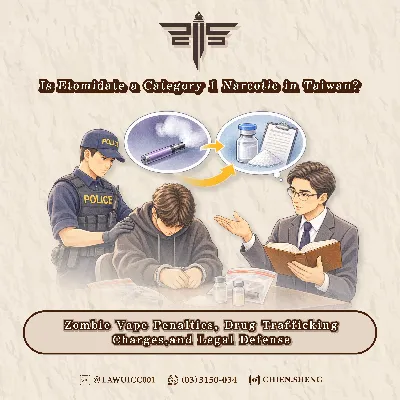 Is Etomidate a Category 1 Narcotic in Taiwan? Zombie Vape Penalties, Drug Trafficking Charges, and Legal DefenseEtomidate, commonly associated with zombie vapes, is now classified as a Category 1 narcotic in Taiwan, exposing certain drug offenses to exceptionally severe criminal penalties. This guide explains the consequences of possession, use, transfer, transportation, and sale, as well as the difference between drug trafficking and other offenses. Learn how forensic evidence, statutory sentence reductions, addiction treatment, and early legal defense may affect an etomidate criminal case.毒品案件知識文 2026.11.02