1. What Is a Money Mule Under Taiwan Law?
1.1 ATM Withdrawal Mules, Cash Pickup Mules, and Dummy Accounts
A money mule is a person who receives, withdraws, transfers, transports, or collects money on behalf of another individual or organization, particularly when the funds are connected to fraudulent or otherwise unlawful activities.
In Taiwan, fraud investigations frequently involve several different roles. An ATM withdrawal mule, commonly called a che shou (車手), withdraws money from bank accounts or ATMs according to instructions from another person. A cash pickup mule may collect cash directly from fraud victims or receive money from other individuals before delivering it to a designated recipient. A dummy account holder, commonly associated with the term ren tou zhang hu (人頭帳戶), provides or allows another person to use a bank account that later becomes involved in suspicious financial transactions.
These roles may overlap, but they are not legally identical. A person who merely receives a bank transfer is not necessarily in the same position as someone who knowingly withdraws fraud proceeds or participates in an organized criminal operation. The specific conduct, surrounding circumstances, and available evidence must be examined before determining criminal liability.
1.2 Can a Scam Victim Be Charged With Fraud or Money Laundering?
Yes. A person who was deceived by a fraud syndicate may still become a criminal suspect if their actions are connected to the movement of fraud proceeds.
For example, someone may believe they are assisting a romantic partner, working for a legitimate employer, or receiving payment for a cryptocurrency transaction. When the money is later identified as fraud proceeds, investigators may examine whether that person knowingly assisted the scheme.
However, being named as a suspect does not mean the person is guilty. Taiwanese criminal law generally requires proof of the elements of the charged offense, including the necessary mental state. Depending on the offense, this may involve direct intent or indirect intent. The prosecution must evaluate whether the accused person understood the relevant circumstances, whether they accepted the possibility of participating in unlawful conduct, and whether the evidence establishes the alleged offense. A genuinely deceived individual may have grounds to argue that the required criminal intent was absent.
2. Three Common Scams That Turn Victims Into Money Mules
2.1 Online Dating and Romance Scams
Romance scams are a common way fraud syndicates manipulate victims into handling money.
A scammer may establish an emotional relationship through a dating application, social media platform, or messaging service. After building trust, the scammer may ask the victim to receive money, provide a bank account, withdraw cash, or transfer funds to another person. The explanation may involve helping a business partner, receiving company payments, handling emergency funds, or assisting with a supposedly legitimate transaction.
Because the victim trusts the person making the request, they may not realize that the money originated from other fraud victims. When the transactions are discovered, the person who received or withdrew the funds may be investigated for fraud or money laundering.
The defense should examine how the relationship developed, what explanations were provided, whether the accused person had reason to recognize the fraud, and whether the communications support genuine deception.
🔗Related Chien Sheng successful case: Romance Scam on a Dating App — Victim Lost Money and Was Then Used as a Money Mule and Dummy Account Holder; Lawyer Secured a Non-Prosecution Decision
2.2 Fake Jobs and Part-Time Employment Scams
Fraud syndicates also use fake job advertisements to recruit unsuspecting individuals.
These advertisements may promote flexible working hours, easy part-time income, purchasing assistance, payment processing, or remote administrative work. After the applicant is supposedly hired, the employer may instruct them to receive payments into a personal bank account, withdraw cash, purchase cryptocurrency, or deliver funds to a designated person. The applicant may believe these transactions are ordinary employment duties. However, legitimate employment arrangements do not automatically explain why an employee must use a personal bank account to receive unidentified third-party payments or transfer cash to unknown recipients.
During a criminal investigation, prosecutors may examine the recruitment process, promised compensation, job instructions, transaction amounts, and whether the circumstances should have raised suspicion.
💡A defense strategy should focus on the complete employment communications and the accused person's actual understanding of the work, rather than relying solely on the claim that the transactions were performed for an employer.
2.3 Cryptocurrency and Triangular Fraud Schemes
Triangular fraud is another common source of criminal investigations involving innocent account holders.
In a typical triangular fraud arrangement, a scammer communicates separately with a genuine seller and a fraud victim. The scammer may pretend to purchase cryptocurrency or goods from the seller while directing the fraud victim to transfer money into the seller's bank account. After receiving the payment, the seller delivers the cryptocurrency or goods to the scammer, believing the transaction is legitimate. The fraud victim later reports the incident, and the seller's bank account may become associated with the fraudulent payment. As a result, the seller may face account restrictions and criminal investigation despite believing they had completed an ordinary commercial transaction.
Important evidence may include:
- transaction records
- cryptocurrency wallet addresses
- exchange records
- order confirmations
- payment instructions
- communications with the purported buyer.
The critical legal question is whether the seller knowingly participated in the fraud or was independently deceived by the person arranging the transaction.
🔗Related Chien Sheng successful case: Cryptocurrency Trading and Triangular Fraud — Warning Account Investigation and Successful Non-Prosecution Defense
3. Criminal Liability for Money Mule Cases in Taiwan
3.1 Fraud, Aggravated Fraud, and Money Laundering
Money mule investigations in Taiwan may involve several different criminal offenses. Ordinary fraud under Article 339 of Taiwan's Criminal Code generally concerns obtaining property or unlawful benefits through deception.
Aggravated fraud under Article 339-4 involves specified aggravating circumstances, such as certain forms of group participation or other conduct meeting the statutory requirements. The prosecution must establish the relevant aggravating elements rather than assuming every fraud-related transaction constitutes aggravated fraud.
The Money Laundering Control Act addresses conduct involving criminal proceeds and other statutorily defined money laundering activities. Its application depends on the specific transaction, underlying criminal conduct, and required legal elements. In some cases, the Fraud Crime Hazard Prevention Act may also be relevant, particularly where the alleged conduct involves offenses or aggravating circumstances covered by that legislation.
➠Different statutes may apply to different aspects of the same investigation. The fact that money passed through an individual's bank account does not, by itself, establish every element of fraud or money laundering. Prosecutors must determine the accused person's role, conduct, and criminal intent based on the evidence.
3.2 Criminal Intent and Indirect Intent
Criminal intent is often one of the most important issues in money mule cases.
Under Article 13 of Taiwan's Criminal Code, intent includes situations in which a person knows the facts constituting an offense and intends their occurrence. It also includes circumstances in which the person foresees the occurrence of those facts and does not act contrary to their occurrence.
The latter concept is commonly referred to as indirect intent or dolus eventualis. For example, a person who strongly suspects that money comes from fraud but proceeds with the transactions while accepting that possibility may face arguments that indirect intent existed. However, merely showing that a transaction was unusual or that a person could have been more careful does not automatically prove indirect intent.
The distinction between negligence, suspicion, genuine deception, and acceptance of criminal conduct requires careful analysis. Relevant evidence may include the explanations provided by the scammer, the accused person's experience, the transaction arrangements, communications, warnings received, and conduct before and after the transfers.
➠A successful non-prosecution defense may depend on demonstrating that the evidence does not establish the required criminal intent.
4. Three Defense Strategies to Seek Non-Prosecution
4.1 Preserve Complete Communication Records
The first defense strategy is to preserve all communications with the individuals who arranged the transactions.
LINE, Telegram, WhatsApp, social media messages, dating application conversations, emails, and recruitment records may reveal how the accused person became involved. These records can establish what the other party claimed, how trust was developed, what instructions were given, and whether the accused person was misled about the purpose of the transactions.
For example, a complete conversation may show that the accused person repeatedly asked about the legitimacy of the work and received fabricated explanations. It may also reveal whether the scammer impersonated an employer, romantic partner, customer, or financial intermediary. Preserve the original records wherever possible, including dates, account identifiers, attachments, and transaction instructions. Avoid deleting messages or selectively presenting only favorable excerpts.
💡A complete and authentic communication history is generally more persuasive than an isolated screenshot without context.
4.2 Reconstruct Financial Transactions and Personal Losses
The second strategy is to organize the entire flow of funds.
Relevant evidence may include bank statements, transfer receipts, ATM withdrawal records, cryptocurrency transaction histories, purchase orders, and documents showing payments made by the accused person. A chronological transaction record can help identify who sent the money, when it was received, what instructions were given, and where the funds subsequently went. If the accused person personally lost money to the same fraud syndicate, evidence of those losses may support the argument that they were also deceived.
For example, a person who transferred substantial personal savings to a supposed romantic partner before being instructed to handle third-party payments may have evidence relevant to their genuine belief in the relationship.
➠However, personal financial losses do not automatically exclude criminal intent. A person may be both a fraud victim and a participant in separate unlawful conduct. The value of this evidence depends on whether the losses, communications, and transactions collectively support the claimed lack of criminal intent.
4.3 Use Objective Evidence to Challenge False Allegations
The third strategy is to identify independent evidence capable of confirming or disproving specific allegations.
If investigators allege that the accused person collected cash at a particular location, relevant evidence may include mobile phone connection records, cell tower data, surveillance footage, transportation records, workplace attendance, and transaction timestamps.
Cell tower location data may help establish whether a mobile device was connected to a particular geographic area at a relevant time. However, cell tower records generally provide approximate location information rather than definitive proof of a person's exact position. Their reliability and significance depend on technical factors and corroborating evidence. A lawyer may request that prosecutors investigate relevant telecommunications records or other objective evidence through legally authorized procedures.
🔗Related Chien Sheng successful case: Accused of Collecting Fraud Proceeds — Cell Tower Location Evidence Helped Disprove the Allegation and Secure Non-Prosecution
5. What Happens During a Taiwan Money Mule Investigation?
5.1 Police Questioning and Evidence Collection
A money mule investigation may begin when a fraud victim reports an unauthorized or deceptive transaction.Police may trace the funds to a bank account, identify an ATM withdrawal, examine a cryptocurrency transfer, or investigate an individual who allegedly collected cash. The account holder or suspected money mule may then receive a police notice requesting attendance for questioning.
Investigators may ask why the money was received, who instructed the transaction, whether compensation was promised, and what the accused person understood about the source of the funds. Individuals should answer truthfully while understanding their procedural rights, including the right to remain silent and the right to seek assistance from a lawyer. A person should not speculate about facts they cannot remember or provide explanations that are inconsistent with available records.
⚠️Early legal preparation can help identify relevant evidence and reduce the risk of inaccurate or incomplete statements.
5.2 Prosecutorial Review and Non-Prosecution Decisions
After police complete the initial investigation, the case may be referred to a district prosecutors office. The prosecutor evaluates whether the available evidence establishes the alleged criminal offense and whether prosecution is legally justified.
In Taiwan, a non-prosecution decision may be appropriate where the statutory requirements are met, including circumstances in which the evidence is insufficient to establish criminal liability. A non-prosecution decision based on insufficient evidence should be distinguished from deferred prosecution, which is a separate legal disposition with different requirements and consequences. For a person who was genuinely deceived into handling fraud proceeds, the defense may focus on demonstrating that the prosecution cannot establish the necessary criminal intent.
Relevant evidence may include communications, financial losses, transaction records, independent location evidence, and other circumstances supporting the accused person's account. No lawyer can guarantee a non-prosecution decision. The outcome depends on the evidence, applicable law, and prosecutor's assessment.
6. What If Your Bank Account Becomes a Warning Account?
6.1 Why Banks Restrict Accounts Linked to Fraud
In Taiwan, a bank account connected to suspected fraud may be designated as a warning account following notification by the competent authorities.
A warning account, commonly called a jing shi zhang hu (警示帳戶), may be subject to restrictions affecting withdrawals, transfers, and other banking services. Related accounts may also become subject to additional restrictions under applicable banking and anti-fraud procedures. These measures are intended to prevent the movement of suspected criminal proceeds and support investigations.
➠However, an account being designated as a warning account does not automatically mean the account holder has committed fraud or money laundering. The administrative or banking consequences of an account restriction must be distinguished from criminal liability.
6.2 How to Protect Your Rights and Preserve Evidence
If your account becomes a warning account, first identify the authority responsible for the notification and the case associated with the restriction. Preserve bank statements, transaction details, communication records, and documents showing the legitimate purpose of the payments.
If the restriction resulted from a triangular fraud transaction, retain evidence of the underlying sale, cryptocurrency transfer, or commercial arrangement. Do not delete relevant communications or attempt to conceal transactions.
A lawyer can help assess the criminal investigation, identify evidence supporting your position, and explain the applicable procedures for seeking removal of account restrictions when legally available. Account restrictions do not necessarily disappear immediately after a person receives a favorable criminal disposition. The applicable procedures and requirements should be confirmed separately.
7. Common Defense Mistakes in Money Mule Cases
7.1 Why Saying “I Did Not Know” May Be Insufficient
One common mistake is assuming that simply denying knowledge of fraud will be enough to avoid prosecution. A statement such as “I did not know the money came from fraud” may be accurate, but prosecutors may still examine the surrounding circumstances.
For example, investigators may ask why the accused person accepted payments from strangers, withdrew cash immediately, transferred money to unfamiliar recipients, or received compensation for unusual transactions. If these circumstances suggest that the person recognized a substantial possibility of unlawful activity and accepted it, the prosecution may argue that indirect intent existed.
💡The defense must therefore explain the actual transaction process and support that explanation with credible evidence.
7.2 Why Inconsistent Statements and Missing Evidence Matter
Another common mistake is providing incomplete or inconsistent explanations during different stages of the investigation.
A person who is frightened may initially omit important details, confuse transaction dates, or describe events imprecisely. Such inconsistencies can affect how prosecutors assess credibility, particularly when they concern the source of funds or the accused person's understanding of the transaction. Missing communication records may also make it more difficult to reconstruct the deception. For this reason, individuals should preserve evidence promptly, review their records carefully, and avoid guessing when uncertain about specific facts.
➠Legal counsel can help organize the chronology, identify factual disputes, and prepare a coherent defense based on the available evidence.
8. Frequently Asked Questions About Money Mule Cases in Taiwan
Q1: Can I be charged with fraud in Taiwan if I was also scammed?
Yes. A person who was deceived may still become a suspect if their actions were connected to fraud proceeds. However, being investigated does not establish guilt. Criminal liability depends on the applicable offense, evidence, and required criminal intent.
Q2: What is an ATM withdrawal mule in Taiwan?
An ATM withdrawal mule is a person who withdraws money from an account, often following instructions from another individual. Whether the conduct constitutes fraud or money laundering depends on the circumstances and the person's knowledge and intent.
Q3: Can I get a non-prosecution decision if I unknowingly helped a fraud syndicate?
Potentially. If the evidence does not establish the elements of the alleged offense, including the required criminal intent, a non-prosecution decision may be appropriate. The result depends on the individual case.
Q4: Does receiving fraud proceeds in my bank account automatically make me guilty?
No. Receiving money connected to fraud does not automatically establish criminal liability. Investigators must examine the transaction, the account holder's conduct, and whether the required criminal intent can be proven.
Q5: What evidence is useful for proving I was deceived?
Useful evidence may include LINE or Telegram messages, employment advertisements, dating application conversations, bank statements, cryptocurrency transaction records, proof of personal financial losses, and relevant independent records.
Q6: What is indirect intent in a Taiwan fraud case?
Indirect intent refers to circumstances in which a person foresees the occurrence of facts constituting an offense and accepts their occurrence. Whether indirect intent existed must be determined from the evidence and surrounding circumstances.
Q7: Can cell tower records help prove I was not a cash pickup mule?
They may help. Cell tower records can provide approximate location information and may be useful when combined with surveillance footage, attendance records, or other evidence. They do not necessarily establish a person's exact location.
Q8: What should I do if my bank account is designated as a warning account?
Identify the relevant case and notifying authority, preserve all transaction and communication records, and seek legal advice if you are under criminal investigation. The process for lifting restrictions depends on the applicable legal and banking requirements.
Q9: Is non-prosecution the same as deferred prosecution in Taiwan?
No. Non-prosecution and deferred prosecution are different legal dispositions. A non-prosecution decision may be issued where prosecution is not legally warranted, while deferred prosecution involves a separate statutory framework and may include conditions.
Q10: Can a lawyer help me avoid prosecution for money laundering in Taiwan?
A criminal defense lawyer can review the evidence, examine whether the required criminal intent is established, prepare written submissions, request relevant investigative steps, and advocate for non-prosecution when legally appropriate. No outcome can be guaranteed.
9. Conclusion: How to Protect Your Rights and Seek Non-Prosecution
Being deceived into acting as a money mule can have serious consequences in Taiwan. Individuals who believe they are helping a romantic partner, completing legitimate employment duties, or conducting cryptocurrency transactions may unexpectedly become suspects in fraud and money laundering investigations.
However, handling money connected to fraud does not automatically establish criminal guilt. The central legal question is whether the prosecution can prove the required elements of the alleged offense, particularly criminal intent.
Three evidence-based defense strategies are especially important: preserving complete communication records, reconstructing financial transactions and personal losses, and identifying objective evidence capable of confirming or disproving the allegations. Individuals facing police questioning should avoid deleting records, making unsupported assumptions, or relying solely on general statements that they were unaware of the fraud.
🧑🏻⚖️Chien Sheng International Law Firm provides criminal defense assistance in money mule, fraud, money laundering, cryptocurrency fraud, and warning account cases throughout Taiwan. Our attorneys help clients evaluate the evidence, protect their procedural rights, prepare defense submissions, and seek non-prosecution where the legal requirements are satisfied. If you have been deceived into receiving, withdrawing, or transferring suspicious funds, obtaining legal assistance early may help preserve important evidence and clarify your role in the alleged scheme.
【CHIEN SHENG LAW FIRM】
- LINE Online Legal Consultation::@lawuicc001(Click to Consult)
- Appointment by Phone::(03)⠀3150-034
- Payment Methods: Cash|Credit Card|Bank Transfer
【Learn More】

 詐欺案件被告怎麼辦?收到警局通知、帳戶被警示,律師教你把握黃金時間自救|詐欺案件律師推薦收到警局通知、帳戶被警示,可能已被捲入詐欺或洗錢案件。本文教你把握黃金時間,保存證據、避免錯誤筆錄,爭取不起訴或無罪。詐欺案件知識文 2026.05.19
 Lineage Online Triangle Scam in Taiwan: What If You Paid for Game Items or Your Bank Account Was Flagged?A Lineage Online triangle scam can leave buyers without their money or game items, while innocent sellers may face frozen bank accounts and criminal investigations. Learn how three-party gaming scams work in Taiwan, what evidence to preserve, how to respond to police questioning, and how a criminal lawyer can assist with fraud complaints, non-prosecution defense, and warning account removal.詐欺案件知識文 2026.09.24
 虛擬貨幣會被警察扣押嗎?USDT、比特幣查扣程序、區塊鏈金流追蹤與洗錢罪刑事辯護完整解析USDT、比特幣放在冷錢包或海外交易所,就不會被警察扣押嗎?其實虛擬貨幣可能依法遭查扣,鏈上交易紀錄也可能成為詐欺、洗錢案件的重要金流證據。本文解析虛擬資產扣押程序、錢包地址追蹤、犯罪所得沒收及刑事辯護重點,帶您了解如何釐清交易責任與保障合法財產權益。詐欺案件知識文 2026.10.13
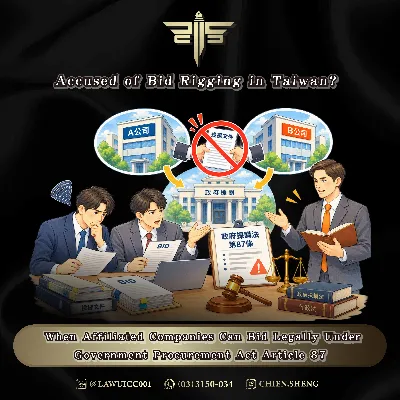 Accused of Bid Rigging in Taiwan? When Affiliated Companies Can Bid Legally Under Government Procurement Act Article 87Can affiliated companies legally compete in the same government procurement tender in Taiwan? A New Taipei District Court acquittal explains why related-company bidding does not automatically constitute bid rigging. This article examines Government Procurement Act Article 87, alleged sham bids, independent bidding decisions, the three-bidder requirement, evidentiary weaknesses, and the principle of reasonable doubt. Learn how businesses can protect their rights when facing procurement-related criminal allegations. This case is analyzed for legal education and was not handled by Chien Sheng International Law Firm.詐欺案件知識文 2026.10.27