1. Why Can Giving an ATM Card to a Scam Group Become a Fraud or Money Laundering Case?
If you are searching for “what happens if I gave my ATM card to a scammer in Taiwan,” “bank account used for fraud Taiwan,” “providing three bank accounts Taiwan,” “mule account non-prosecution Taiwan,” “aiding fraud lawyer Taiwan,” or “what to do if my bank account becomes a warning account,” your case may already have entered the criminal investigation stage.
Your bank account may suddenly have been designated as a warning account, you may have received a notice from the police requesting an interview, or you may already have received a summons from a District Prosecutors Office. The alleged offenses may include fraud, aiding fraud, money laundering, aiding money laundering, or a violation of Article 22 of the Money Laundering Control Act.
Many defendants are shocked because they believe they were victims themselves. They may have been deceived by a fake employer, loan company, investment platform, romantic partner, recruiter, or supposed financial service provider, only to later discover that they are being investigated as a suspect in a fraud case.
In practice, however, anyone who provides an ATM card, bank passbook, PIN, online banking username and password, verification code, or other means of controlling a bank account may be investigated as a potential provider of a mule account if that account is subsequently used to receive or transfer fraud proceeds.
➠That does not mean every person who provides an account is automatically guilty. It also does not mean that providing three or more accounts eliminates every possible defense.
Chien Sheng International Law Firm has handled fraud, bank account, ATM card, fake loan, fake employment, mule account, aiding fraud, aiding money laundering, and Money Laundering Control Act cases. In many cases, the account holder was not a member of a fraud organization but was instead deceived into surrendering account information.Even where three or more accounts were provided, the complete communication history, reasons for providing the accounts, circumstances of the deception, and the defendant’s actual understanding at the time may still become important evidence supporting non-prosecution or acquittal.
1.1 What Is a Mule or Dummy Bank Account in Taiwan?
Fraud groups generally avoid using bank accounts registered directly in their own names because doing so would make it easier for law enforcement authorities to trace the money back to them.
Instead, they may obtain accounts belonging to other people and instruct fraud victims to transfer money into those accounts. The funds may then be withdrawn by cash mules or transferred through additional accounts, creating multiple layers in the financial trail.
When police trace the flow of funds, the registered account holder is often one of the first identifiable individuals.Therefore, even if you never personally spoke to the fraud victim, never participated in the fraudulent representations, and never personally received the victim’s money, investigators may still examine whether you knowingly provided your account to facilitate the offense.
Under Article 339 of the Criminal Code(刑法第339條), a person who, with the intent to obtain an unlawful benefit for themselves or another person, uses fraud to cause another person to deliver property may be subject to criminal liability for fraud.
⚠️Where statutory aggravating circumstances exist, such as fraud committed jointly by three or more persons, impersonation of a government agency or public official, or certain forms of fraud carried out through the Internet or other communication media, the case may also involve aggravated fraud under Article 339-4 of the Criminal Code.
1.2 Aiding Fraud and Aiding Money Laundering
If a person only provided a bank account but did not personally participate in fraudulent communications, withdrawals, or transfers, investigators may examine whether the conduct constitutes aiding fraud or aiding money laundering.Article 30 of the Criminal Code provides for criminal liability where a person assists another in committing an offense. The punishment of an aider may be reduced in comparison with that of the principal offender.
In a bank-account fraud case, prosecutors may argue that providing an ATM card, PIN, online banking credentials, or account control objectively allowed a fraud group to receive, withdraw, or transfer criminal proceeds.
However, criminal liability should not be determined solely by asking whether the account was ultimately used by scammers.A critical question is the defendant’s state of mind: Did the defendant know, or at least foresee and accept the possibility, that the account would be used for fraud or money laundering?
If the defendant was deceived by a fake loan, fake job, romance scam, investment scam, or account-verification scheme and genuinely did not understand that the ATM card or account would be used to receive fraud proceeds, the issue of criminal intent may become a central part of the defense.
2. Common Scams Used to Obtain ATM Cards and Bank Accounts
Many people ask the same question after receiving a police notice: “I was also scammed. Why am I now the defendant?”
This situation is common in ATM card and mule account cases because fraud groups do not only deceive victims into transferring money. They also deceive other people into providing the accounts used to receive that money.
2.1 Fake Job and Part-Time Work Scams
Fake employment advertisements may appear on social media, messaging apps, or job platforms and promise high compensation for simple work with little or no experience required.
After the applicant adds the recruiter on LINE or another messaging service, the supposed employer may claim that an ATM card or bank account is needed for salary payments, account verification, company review, financial testing, or internal accounting procedures.The applicant may then be instructed to mail an ATM card, provide the PIN, or disclose online banking credentials.
➠The applicant believes they are completing a legitimate employment procedure, while the fraud group actually obtains control of the bank account.
2.2 Fake Loan and Credit-Building Scams
Fake loan schemes often target people who urgently need money.
The supposed lender may claim that the applicant must provide an ATM card, passbook, online banking information, or multiple bank accounts to complete loan approval, create transaction history, improve creditworthiness, verify cash flow, or receive the loan.
The fraud group may even transfer money into the account and tell the applicant that the funds are “test transactions,” “loan review funds,” or “company money.”n reality, the funds may have come from another fraud victim.
⚠️This distinction is extremely important in criminal cases because the defendant may genuinely believe that the transactions are part of a loan process rather than proceeds of fraud.
2.3 Romance, Investment, and Account Verification Scams
In romance scams, the other party may first spend time establishing trust before claiming to be overseas, unable to use their own account, or in need of assistance receiving money.
Investment and cryptocurrency scams may use similar methods. The victim may be asked to provide a bank account, virtual asset account, identification documents, SIM card, phone number, online banking credentials, or one-time verification code.Other schemes may instruct the person to send ATM cards through convenience-store delivery services, courier services, bus delivery services, or face-to-face delivery.
The common feature is that the person is given an apparently legitimate explanation for surrendering control of the account.
➠For criminal defense purposes, the complete circumstances surrounding the transaction matter. Relevant evidence may include how the scammer first contacted the defendant, what representations were made, why the defendant believed those representations, whether contracts or advertisements existed, whether compensation was received, whether the defendant conducted any verification, and what the defendant did after discovering the fraud.
3. Does Providing Three or More Bank Accounts Automatically Mean You Are Guilty?
No. Providing three or more accounts creates substantially greater criminal risk, but it does not mean that the number of accounts alone automatically establishes guilt.This distinction is especially important under Article 22 of Taiwan’s Money Laundering Control Act.
3.1 Taiwan Money Laundering Control Act Article 22
Article 22, Paragraph 1 of the Money Laundering Control Act generally prohibits a person from delivering or providing a financial institution account, virtual asset service account, or third-party payment account for another person’s use, subject to exceptions such as ordinary commercial or financial practices, trust relationships between relatives or friends, or other legitimate reasons.
Article 22, Paragraph 3 provides criminal penalties for specified circumstances involving prohibited account provision.
One of those circumstances concerns providing a total of three or more accounts or account numbers.Accordingly, if a person provides three or more ATM-card-linked bank accounts or other covered accounts, the case may fall within the criminal penalty provisions of Article 22. The statutory punishment may include imprisonment for up to three years, detention, or a fine of up to NT$1 million, or both imprisonment and a fine.
💡However, this does not mean that “three accounts = automatic conviction.”The prosecution must still establish the elements required for criminal liability.
3.2 Why Criminal Intent Still Matters
The legislative reasoning for Article 22 of the Money Laundering Control Act specifically discusses fake loan and employment schemes.
The legislative reasoning explains that legitimate loan applications or employment arrangements generally require only account information for receiving loans or salary payments. They ordinarily do not require the applicant or employee to surrender the tools or information necessary to control the payment functions of the account, such as an ATM card, security device, password, or verification code.
➠Therefore, providing account-control information in the name of applying for a loan or employment will generally not itself constitute a legitimate reason under the provision.
However, the legislative reasoning also expressly recognizes an important distinction:「惟倘若行為人受騙而對於構成要件無認識時,因欠缺主觀故意,自不該當本條處罰。」In English, this means that if the person was deceived and therefore lacked awareness of the elements of the offense, the absence of subjective criminal intent may mean that the person does not fall within the criminal punishment contemplated by the provision.
This sentence is extremely important in cases involving fake jobs, fake loans, and other schemes used to obtain bank accounts.The law does not simply ask how many accounts were provided. It is also necessary to examine what the defendant knew and understood when the accounts were provided.
3.3 Being Deceived Into Providing Multiple Accounts
The legislative reasoning for Article 22, Paragraph 3 also recognizes that people provide accounts for many different reasons and that the degree of culpability may differ from case to case.
Providing three or more accounts is treated more seriously because multiple accounts may objectively increase the risk of mule-account and money-laundering activity.However, the circumstances of the individual case still matter.
For example, a person urgently seeking a loan may be told that three bank accounts are necessary to create a financial record. A job applicant may be told that several accounts are required for payroll verification. Another person may receive what appears to be a formal contract or company documentation.
From the outside, the person may appear to have provided several mule accounts. But after examining the complete messages, advertisements, delivery records, contracts, financial circumstances, and scammer’s representations, a different picture may emerge.
🧑🏻⚖️The defense should therefore focus on whether the person knowingly participated in unlawful account provision or was themselves deceived by the fraud group.
4. What Should You Do After Giving Your ATM Card to a Scammer?
If you discover that your ATM card has been provided to a suspicious person, your account has become a warning account, or you have received a police or prosecutors office notice, evidence preservation should become an immediate priority.
Do not delete conversations, throw away delivery receipts, or casually prepare a confession or apology without understanding its possible legal consequences.
4.1 Preserve Messages, Advertisements, and Delivery Records
Preserve all LINE, Telegram, Facebook, Instagram, SMS, email, job-platform, loan-platform, investment-platform, and dating-app conversations.Also preserve call logs and screenshots.
A successful defense usually requires more than simply telling investigators, “I was scammed.”The evidence should help reconstruct how the other party presented themselves, what they promised, how they gained your trust, why they requested the ATM card or banking information, and why you believed the request was legitimate.
- Advertisements
- website addresses
- usernames
- phone numbers
- company names
- fake contracts
- job postings
- loan advertisements
and investment materials should also be preserved.
If you mailed an ATM card through a convenience store, courier, delivery service, bus delivery service, or another method, preserve the receipt, tracking history, recipient information, and payment records.
4.2 Contact the Bank and Preserve Transaction Records
If the account has not yet been restricted, contact the bank promptly to determine whether the card or online banking access can be suspended or otherwise secured. If the account has already become a warning account, preserve the bank’s notices, transaction statements, and other relevant documents.
These records may help establish when money entered the account, how it was withdrawn or transferred, whether fraud victims transferred funds into the account, and whether the defendant personally conducted any transactions.The timing of transactions may also be compared with the defendant’s communications and physical whereabouts.
4.3 Avoid Statements That Could Be Misinterpreted
Do not independently contact suspected fraud-group members simply to demand that they return the ATM card or “fix the problem.”They may continue manipulating, threatening, or misleading you, and additional communications may complicate the evidence.
Another common problem occurs during police questioning.A frightened defendant may repeatedly say, “I know I was wrong,” or “I should never have given them my card.”These statements may be intended only as expressions of regret. However, they should not be confused with an admission that the defendant knew, at the time of providing the card, that the recipient was a fraud group.
➠The legally important question is the defendant’s knowledge and intent at the time of the conduct.
5. Why Are Police Interviews and Prosecutor Questioning So Important?
ATM card cases may appear straightforward, but the first police interview can have a major impact on the direction of the investigation.
The police and prosecutors will usually try to determine why the account was provided, how many accounts were involved, what account-control information was surrendered, whether compensation was received, and what the defendant knew about the other party.
5.1 What Investigators Usually Ask
Common questions include:
- Why did you provide your ATM card?
- How many bank accounts did you provide?
- Did you provide the PIN?
- Did you provide online banking credentials?
- Did you provide verification codes?
- Did you receive compensation?
- Did you know the other party’s real identity?
- Did you verify the company?
- Did you withdraw or transfer any money?
- When did you discover something was wrong?
- Did you report the matter to the police or bank?
➠These questions are not merely procedural. The answers may directly affect whether investigators believe the case involves a deceived account holder, aiding fraud, aiding money laundering, an Article 22 violation, or direct participation in fraud or money laundering.
5.2 Why Your First Statement Can Affect the Entire Case
Suppose the police statement only records:“I knew people should not give ATM cards to strangers, but I gave mine anyway.” the statement fails to explain the fake loan, job recruitment, financial verification, investment platform, or other deceptive representations, prosecutors may interpret the statement as evidence that the defendant knowingly accepted the risk of criminal use.
By contrast, a complete statement may explain how the defendant was approached, what the scammer said, what the defendant believed the transaction was for, why the explanation appeared credible, whether abnormal compensation was received, whether the defendant participated in withdrawals or transfers, and what happened after the defendant discovered the problem.
The defendant’s background and circumstances may also be relevant. For example, investigators may consider whether the defendant had prior experience with financial transactions, whether the defendant urgently needed employment or financing, whether apparently legitimate company information was provided, and whether the defendant immediately stopped cooperating, reported the matter, or suspended the account after discovering suspicious activity.
➠For this reason, simply attending a police interview and saying “I was scammed” may not be enough. A criminal defense lawyer can help organize the timeline, identify relevant evidence, and ensure that the defendant’s actual state of mind is clearly explained.
6. What If You Also Withdrew or Transferred Money?
The criminal risk may become significantly higher if the defendant did more than provide an ATM card or account.
If the defendant also withdrew money, transferred funds, purchased cryptocurrency, or delivered cash to another person, prosecutors may investigate whether the defendant directly participated in processing fraud proceeds.
6.1 Providing an Account vs. Handling Fraud Proceeds
A case involving only the provision of an ATM card, PIN, or account control may focus on aiding fraud, aiding money laundering, or Article 22 of the Money Laundering Control Act.
However, if the defendant followed instructions to withdraw incoming money and hand it to another person, or transferred the funds into another mule account, prosecutors may argue that the defendant participated in concealing, transferring, or handling criminal proceeds.
➠The legal characterization may therefore become substantially more serious.
6.2 When You May Be Investigated as a Principal Offender
If investigators believe the defendant had communication and coordinated conduct with other members of the fraud group, the case may be investigated as direct fraud or money laundering rather than merely aiding another person’s offense.Depending on the circumstances, aggravated fraud under Article 339-4 of the Criminal Code may also become relevant.
However, withdrawing or transferring money does not automatically eliminate every defense.The investigation should still examine why the defendant handled the money, what instructions were given, what the defendant believed the money represented, and whether the defendant knew the funds came from fraud victims.
For example, the scammer may have described the money as loan-review funds, company funds, investment-platform money, payroll transactions, or temporary collection payments.These circumstances require careful examination of messages and financial records.
🚨Nevertheless, cases involving actual withdrawals, transfers, cryptocurrency purchases, or cash delivery generally involve greater criminal exposure than cases involving account provision alone.
7. How Can a Criminal Lawyer Seek Non-Prosecution or Acquittal?
A defense in an ATM card or mule account case should not consist solely of the statement, “I was also scammed.”An effective defense must connect the legal elements of the alleged offense with the defendant’s conduct, state of mind, evidence, and complete factual circumstances.
7.1 Reconstructing the Scam Timeline
The first step is usually to reconstruct the entire sequence of events.This may begin with the first advertisement or message and continue through the initial contact, the other party’s claimed identity, promises made to the defendant, delivery of the ATM card, disclosure of the PIN or online banking information, suspicious transactions, discovery of the scam, suspension of the account, police report, and subsequent investigation.
Each point in the timeline may help establish what the defendant knew at a particular moment.
This is especially important because knowledge acquired after discovering the fraud should not automatically be treated as proof of what the defendant knew when the ATM card was originally provided.
7.2 Proving Lack of Criminal Intent
Evidence may include chat records, advertisements, fake contracts, employment documents, loan applications, delivery receipts, logistics records, bank statements, suspension records, police reports, call logs, and other materials.
The purpose is not simply to collect as many documents as possible.The evidence should explain why the defendant believed the other party and why the defendant lacked the criminal intent required for the alleged offense.
This becomes particularly important in cases involving Article 22 of the Money Laundering Control Act, because the legislative reasoning expressly addresses situations in which a person is deceived and lacks awareness of the relevant criminal elements.
7.3 Distinguishing a Scam Victim From an Account Seller
One of the most important questions in a mule-account investigation is whether the defendant received compensation for providing the account.If a person knowingly sells or rents an account for money, commission, or another benefit, the case may be viewed differently from one involving a person deceived by a fake employer or lender.
However, the mere presence of money does not necessarily answer the question. The nature of the payment must be examined. Was it payment for providing the account?Or was the defendant told that it was salary, a loan disbursement, a refund, a task payment, a financial test transaction, or another legitimate-looking payment?
Messages and transaction records may be essential to determining the answer.
💡A criminal lawyer may therefore focus on the difference between “knowingly providing an account for compensation” and “providing an account because the defendant was deceived into believing there was a legitimate transaction.”
8. What If Your ATM Card Was Lost, Stolen, or Used Without Permission?
Not every fraud-related bank account case involves voluntarily giving an ATM card to another person.Some defendants claim that the ATM card was lost, stolen, or otherwise obtained and used without their knowledge.These cases can be difficult because investigators may ask how another person obtained both the card and the PIN.
➠Nevertheless, a lost or stolen ATM card does not automatically make a defense impossible.
8.1 Evidence That May Support Unauthorized Use
Relevant evidence may include the time and location where the ATM card was lost, the defendant’s usual method of storing the PIN, prior access by another person, bank suspension records, police reports, account-use history, suspicious transaction times, ATM locations, surveillance footage, communications, and evidence of other personal information being compromised.
For example, if an ATM withdrawal occurred at a location far from where the defendant can be independently shown to have been at that time, the discrepancy may become relevant.
➠Similarly, surveillance footage showing another person conducting the transaction may provide important evidence.
8.2 Establishing Reasonable Doubt
A defense based on a lost or stolen ATM card should generally be supported by objective evidence rather than relying only on the defendant’s statement.
Transaction records, locations, timelines, communications, surveillance footage, and account-use patterns may collectively help establish a reasonable alternative explanation.
In a criminal case, the issue is whether the prosecution can prove the charged offense to the required standard. Therefore, the defense may focus on whether the overall evidence leaves reasonable doubt as to whether the defendant knowingly provided or participated in the criminal use of the account.
9. When Should You Contact a Criminal Defense Lawyer?
If you have already received a notice from a police station, precinct, or District Prosecutors Office, or your bank account has been designated as a warning account, it may be appropriate to seek legal advice before giving a formal statement.Early legal assistance becomes particularly important where three or more accounts were provided because Article 22 of the Money Laundering Control Act may become directly relevant.The same applies where you provided online banking credentials, verification codes, or account-control tools in addition to the ATM card.
Legal assistance is also particularly important if you withdrew money, transferred funds, purchased cryptocurrency, or delivered cash to another person. In such circumstances, the investigation may extend beyond account provision and examine direct participation in fraud or money laundering.
If you received commissions, transportation fees, task payments, or other money from the other party, the nature of those payments should also be carefully explained and supported with evidence.Evidence problems are another reason to seek assistance early. If LINE messages were deleted, your phone was lost, an account was logged out, or you blocked the scammer, reconstructing the original communications may become more difficult over time.
➠The earlier the complete facts and available evidence are organized, the greater the opportunity to present a coherent explanation during the investigation.
10. Frequently Asked Questions About ATM Card and Bank Account Fraud in Taiwan
10.1 I gave my ATM card to a scammer. Will I definitely be charged with fraud?
No. The fact that you provided an ATM card may trigger a criminal investigation, but criminal liability depends on the specific facts, including why you provided the card, what you knew at the time, whether you received compensation, whether you participated in withdrawals or transfers, and what evidence supports your explanation.
Possible legal issues may include aiding fraud under Article 30 of the Criminal Code, fraud under Article 339, aggravated fraud under Article 339-4, money laundering offenses, or Article 22 of the Money Laundering Control Act.
10.2 If I provided three ATM cards or three bank accounts, am I automatically guilty?
No.Providing three or more accounts is specifically relevant under Article 22, Paragraph 3 of the Money Laundering Control Act and creates serious criminal exposure.
However, the number of accounts does not by itself resolve every element of criminal liability.The defendant’s state of mind and the circumstances under which the accounts were provided remain important. In particular, the legislative reasoning recognizes situations in which a person was deceived and lacked awareness of the relevant elements.
10.3 I gave the accounts away because I was applying for a loan. Can I still argue that I was scammed?
Potentially, yes. However, simply saying “I was applying for a loan” is usually not enough.
Relevant evidence may include the original loan advertisement, LINE messages, fake loan contracts, the supposed loan officer’s identity, the explanation given for requiring ATM cards, delivery records, financial records, and what you did after discovering the fraud.The goal is to demonstrate why you genuinely believed you were participating in a loan process rather than knowingly providing accounts for criminal use.
10.4 My bank account became a warning account. Does that mean I have already been convicted?
No. A warning account does not itself mean that you have been convicted of a criminal offense.
It generally indicates that the account has been identified in connection with a criminal investigation and is subject to restrictions under the applicable financial and law-enforcement procedures. The criminal investigation and any ultimate determination of criminal liability are separate matters.
10.5 What if I also withdrew the money?
The risk may be significantly higher.
If you withdrew fraud proceeds and delivered them to another person, prosecutors may investigate whether you directly participated in fraud or money laundering rather than merely providing an account. However, the reason for the withdrawal, the instructions you received, your knowledge of the source of the funds, and the complete communication history still need to be examined.
10.6 What if I transferred the money because the other party told me it was a loan-review transaction?
This may become an important part of the defense, but the explanation should be supported by evidence.
Investigators may examine whether the loan arrangement appeared legitimate, whether documentation existed, how the transaction was explained, whether you received compensation, and whether there were warning signs that you recognized or ignored. Messages and transaction records may therefore be crucial.
10.7 Can I receive non-prosecution if I was also a victim of the scam?
A non-prosecution disposition may be possible depending on the evidence and facts of the individual case.The prosecutor will consider whether there is sufficient evidence to establish the alleged offense, including the defendant’s criminal intent.
Evidence showing that the defendant was deceived, lacked awareness of criminal use, did not receive improper compensation, and did not participate knowingly in the handling of fraud proceeds may be relevant to the prosecutor’s decision.
However, each case must be assessed individually.
10.8 Can I still be found not guilty if the case has already gone to court?
Potentially, yes. Being indicted does not itself establish guilt.
At trial, the prosecution still bears the burden of proving the charged offense. The defense may challenge whether the evidence sufficiently proves criminal intent, knowing participation, account provision, money handling, or other required elements.The available defense will depend on the evidence in the individual case.
10.9 Should I delete my conversations with the scammer?
No. Messages with the scammer may be some of the most important evidence showing how you were approached, what false representations were made, and why you provided the account.
Preserve the original messages, screenshots, usernames, phone numbers, advertisements, URLs, contracts, delivery information, and other relevant records.
10.10 Should I hire a lawyer before the first police interview?
If the case involves multiple accounts, withdrawals, transfers, compensation, online banking credentials, cryptocurrency, or other complicated circumstances, obtaining legal advice before the first formal statement may help you understand the legal issues and organize the evidence. The first police statement can become an important part of the investigation, so the timeline and your state of mind at each stage should be explained accurately.
11. Conclusion: Early Action Can Preserve Your Defense Options
Giving an ATM card, bank passbook, PIN, online banking credentials, virtual asset account, or verification code to a scam group can lead to serious criminal consequences in Taiwan. Possible allegations may include fraud, aiding fraud, money laundering, aiding money laundering, aggravated fraud, or violations of Article 22 of the Money Laundering Control Act.
However, the fact that an ATM card was provided does not automatically establish every element of a criminal offense. Likewise, providing three or more accounts creates significant legal risk, but it should not be simplified into the conclusion that three accounts automatically equal guilt.A central issue remains what the defendant knew and intended when the accounts were provided.
- Was the defendant knowingly selling accounts to a fraud organization, or was the defendant deceived by a fake employer, lender, investment platform, romantic partner, recruiter, or supposed financial service provider?
- Did the defendant receive payment for surrendering the accounts, or did the defendant believe they were receiving a salary, loan, or legitimate transaction?
- Did the defendant personally withdraw or transfer fraud proceeds?
- What did the defendant do after discovering suspicious activity?
These distinctions may determine the direction of the case.
The legislative reasoning for Article 22 of the Money Laundering Control Act is particularly important because it expressly addresses circumstances in which a person is deceived and lacks awareness of the relevant elements. This provides an important legal basis for examining criminal intent rather than judging the case solely from the fact that an account was provided.
If you or a family member has been investigated after providing an ATM card, bank account, PIN, online banking information, cryptocurrency account, or verification code, preserve all available evidence immediately. This may include LINE or Telegram conversations, advertisements, delivery records, bank statements, account-suspension records, police reports, usernames, telephone numbers, company information, contracts, and police or prosecutors office notices.
🧑🏻⚖️Chien Sheng International Law Firm has experience handling fraud, money laundering, mule account, fake loan, fake employment, ATM card, and multiple-account cases. Depending on the facts and evidence, a criminal defense lawyer may assist with reconstructing the scam timeline, preparing for police or prosecutor questioning, organizing supporting evidence, drafting criminal defense submissions, and seeking non-prosecution, acquittal, or another legally favorable outcome.
【CHIEN SHENG LAW FIRM】
- LINE Online Legal Consultation::@lawuicc001(Click to Consult)
- Appointment by Phone::(03)⠀3150-034
- Payment Methods: Cash|Credit Card|Bank Transfer
【Learn More】

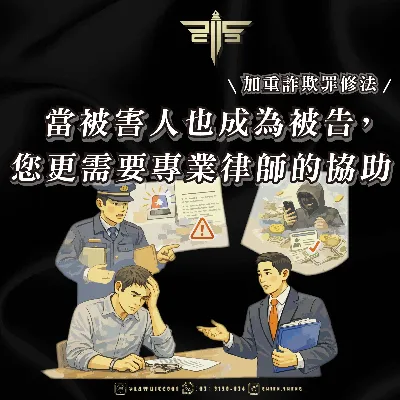 加重詐欺罪修法後刑責更重?人頭帳戶、詐欺車手被告為何更需要專業律師協助?加重詐欺罪修法後刑責提高,人頭帳戶與車手案件風險更高。本文解析被害人變被告時,如何建立詐欺案件辯護策略。詐欺案件知識文 2026.05.27
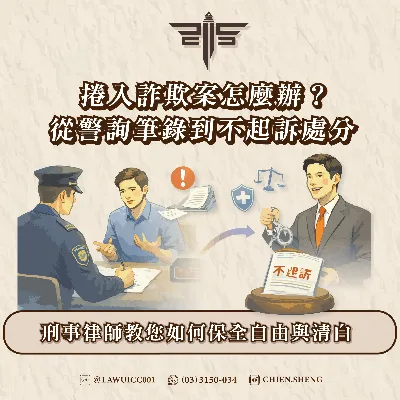 捲入詐欺案怎麼辦?警詢筆錄、地檢署偵查到不起訴處分,刑事律師教你守住清白捲入詐欺案、帳戶變警示戶或收到警詢通知書時,第一份筆錄可能決定案件走向。本文解析警詢、偵查庭到不起訴處分的自保關鍵。詐欺案件知識文 2026.05.20
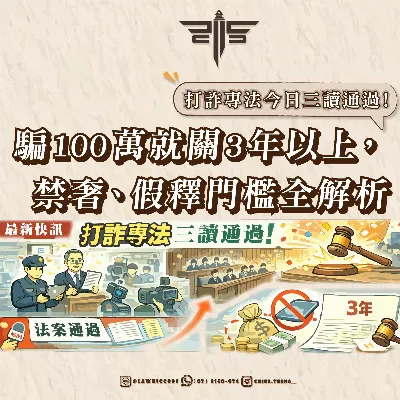 詐欺犯罪危害防制條例修法三讀通過!騙100萬刑度3年起跳、禁奢條款與假釋門檻完整解析詐欺犯罪危害防制條例修法重點一次看:騙100萬刑度3年起跳,禁奢條款、自白減刑與假釋門檻全面加嚴。詐欺案件知識文 2026.05.28
 2026詐欺犯罪危害防制條例修法重點!100萬重罪、六個月賠償、禁奢與假釋新制完整解析2026年詐防條例再升級!加重詐欺財損達100萬元,最低刑度即提高至3年;自首、自白想爭取減刑,還涉及6個月內全額履行和解的新門檻。一次看懂三級重懲、禁奢、首腦重罰、沒收與假釋制度。詐欺案件知識文 2026.08.25