1. How Does Taiwan’s Witness Protection Act Work?
Taiwan enacted the Witness Protection Act to encourage witnesses to provide evidence in serious criminal cases while reducing the risk that they or persons closely connected to them will face retaliation.
The system is especially relevant in organized or network-based crimes because investigators may have difficulty identifying higher-level participants solely through physical evidence, financial records, or surveillance.
1.1 Why Does Taiwan Protect Cooperating Witnesses?
Drug trafficking organizations and fraud networks often operate through several levels of participants. A lower-level participant may know the identity of an upstream supplier, organizer, recruiter, money collector, or other accomplice even when investigators do not yet possess enough evidence to identify that person.
Taiwan’s Witness Protection Act therefore creates incentives and protection mechanisms for qualifying individuals who provide significant information about serious criminal activity.For certain defendants and criminal suspects, cooperation may also lead to reduced or exempted punishment, or in specified circumstances, a non-prosecution disposition.
➟However, cooperation and witness protection are not automatic. Different statutory requirements apply depending on the offense, the individual’s role, the value of the information provided, prosecutorial consent, and the need for protection.
1.2 Which Criminal Cases May Qualify?
Article 2 of Taiwan’s Witness Protection Act defines the categories of criminal cases covered by the Act.The statute includes offenses carrying a statutory minimum sentence of at least three years of imprisonment as well as specifically enumerated offenses.
For fraud cases, Article 339 of Taiwan’s Criminal Code , which governs ordinary fraud, is expressly included among the offenses listed in Article 2 of Taiwan’s Witness Protection Act .Drug-related offenses may also fall within the statutory framework depending on the specific offense involved. In addition, defendants in drug cases must consider the separate cooperation provision contained in Article 17 of the Narcotics Hazard Prevention Act .
➟Therefore, whether the Witness Protection Act applies cannot be determined merely by saying that a case is a “drug case” or “fraud case.” The precise criminal charge and statutory basis should first be identified.
2. Can Cooperating Defendants Receive Reduced Sentences or Immunity?
Article 14 of Taiwan’s Witness Protection Act establishes several mechanisms involving defendants or criminal suspects who provide significant information during an investigation.
The requirements are different depending on whether the person is a principal offender or accomplice in the same covered case or is providing information concerning a different but related, more serious criminal network.
2.1 Co-Offenders Who Provide Evidence Against Other Offenders
Under Article 14, Paragraph 1 of Taiwan’s Witness Protection Act, a defendant or criminal suspect in a qualifying case may receive a reduction or exemption from punishment if, during the investigation, the person provides testimony concerning important facts of the case or criminal evidence concerning other principal offenders or accomplices, and that information enables the prosecutor to pursue those other offenders.
A critical statutory requirement is that the prosecutor must have given prior consent.Therefore, simply telling police or prosecutors the name of another participant does not automatically qualify a defendant for a sentence reduction.The information must satisfy the statutory requirements and must actually enable prosecutorial pursuit of other offenders.
For example, suppose a defendant involved in a drug distribution network knows the identity, contact information, transaction methods, and meeting locations of an upstream supplier. If the defendant provides sufficiently meaningful information that enables prosecutors to pursue that supplier, Article 14 may become relevant if all statutory requirements, including prior prosecutorial consent, are satisfied.
2.2 Cooperation in a More Serious Related Criminal Case
Article 14, Paragraph 2 of Taiwan’s Witness Protection Act (《證人保護法》第14條第2項) addresses a different situation.
A defendant or suspect who is not a principal offender or accomplice in the qualifying case may disclose the upstream source, downstream recipient, or related criminal network of his or her own offense.
If the information enables prosecutors to pursue a defendant in a qualifying criminal case under Article 2, and the criminal circumstances or statutory punishment of the disclosed offense are more serious than those of the cooperating person’s own offense, the prosecutor may, after considering the statutory factors, issue a non-prosecution disposition.
Again, prior prosecutorial consent is required.This mechanism is sometimes described as a form of criminal immunity for a cooperating witness, although its application depends on the specific statutory conditions rather than simply on the person’s willingness to cooperate.
2.3 What Happens If the Cooperating Person Is Still Prosecuted?
Article 14, Paragraph 3 of Taiwan’s Witness Protection Act (《證人保護法》第14條第3項) addresses cases where a person meets the relevant cooperation framework but is nevertheless prosecuted for the offense disclosed through the cooperation.
If the statutory conditions are satisfied, including the prosecutor having given the consent contemplated by Paragraph 2 during the investigation, the court may reduce or exempt the person from punishment.
➟The distinction among Paragraphs 1, 2, and 3 is important. They do not create one universal rule that every cooperating defendant receives the same benefit.
3. How Does Cooperation Work in Taiwan Drug Cases?
Drug cases require additional attention because the Narcotics Hazard Prevention Act contains its own sentence-reduction provision for defendants who identify the source of narcotics.
3.1 The Special Rule Under the Narcotics Hazard Prevention Act
Article 17, Paragraph 1 of Taiwan’s Narcotics Hazard Prevention Act (《毒品危害防制條例》第17條第1項) provides that a person who commits one of the specified offenses under Articles 4 through 8, Article 10, or Article 11, identifies the source of the narcotics, and thereby results in the apprehension of another principal offender or accomplice shall have the punishment reduced or may have it exempted.This provision can be highly important in drug manufacturing, transportation, sale, transfer, and other qualifying narcotics cases.
⚠️However, merely providing a name is not necessarily sufficient.
3.2 “Enabling Prosecution” vs. “Resulting in the Apprehension” of Other Offenders
The wording of the Witness Protection Act and the Narcotics Hazard Prevention Act is not identical.
Article 14, Paragraph 1 of the Witness Protection Act focuses on whether the cooperation enables the prosecutor to pursue other principal offenders or accomplices.By comparison, Article 17, Paragraph 1 of the Narcotics Hazard Prevention Act equires the defendant to identify the source of the narcotics and for that information to result in the apprehension of another principal offender or accomplice.
This distinction can matter significantly in practice.
For example, a defendant may provide detailed information about an upstream supplier, but law enforcement may be unable to arrest or otherwise apprehend that person immediately. Whether the requirements of a particular sentence-reduction provision have been satisfied must therefore be analyzed carefully based on the investigative result and applicable case law.
3.3 Which Rule Applies When Both Provisions Are Relevant?
The Supreme Court of Taiwan addressed the relationship between these provisions in Criminal Judgment No. 101-Tai-Shang-3191.The decision explained that where the special drug-law provision and the Witness Protection Act provision overlap in a qualifying drug case, the special rule under Article 17, Paragraph 1 of the Narcotics Hazard Prevention Act takes priority over Article 14, Paragraph 1 of the Witness Protection Act.
This means defendants in drug cases should not assume that the two provisions are freely interchangeable.
➟The precise charge, information provided, investigative results, timing of cooperation, and prosecutorial position should all be reviewed before deciding which statutory route may apply.
4. Can Taiwan’s Witness Protection Act Apply to Fraud and Aggravated Fraud?
Fraud cases present a separate issue, particularly where a defendant is accused of participating in a large fraud organization.
4.1 Ordinary Fraud Under Criminal Code Article 339
Ordinary fraud under Article 339 of Taiwan’s Criminal Code is expressly listed in Article 2 of Taiwan’s Witness Protection Act.
Accordingly, where the statutory requirements are satisfied, a defendant or criminal suspect in an ordinary fraud case may potentially rely on the cooperation mechanisms provided by Article 14 of Taiwan’s Witness Protection Act.
⚠️Again, this does not mean that every defendant who identifies another person automatically receives a reduced sentence. The requirements concerning the substance and effect of the cooperation and prior prosecutorial consent remain important.
4.2 Aggravated Fraud Under Criminal Code Article 339-4
A more complicated issue arises with aggravated fraud under Article 339-4 of Taiwan’s Criminal Code. Article 339-4 covers aggravated forms of fraud, including certain offenses committed by three or more persons.However, Article 2 of the Witness Protection Act does not expressly list Criminal Code Article 339-4 in the same way that it expressly lists Article 339.
➟This has created an important question in judicial practice: can the cooperation and sentence-reduction mechanism under the Witness Protection Act nevertheless apply to aggravated fraud?
4.3 The Kaohsiung High Court Branch Decision on Analogical Application
In Criminal Judgment No. 113-Jin-Shang-Su-381, the Kaohsiung Branch of the Taiwan High Court addressed this issue.
The court reasoned that aggravated fraud under Criminal Code Article 339-4 is a special aggravated form built upon the basic offense of fraud under Article 339. It further considered the omission of Article 339-4 from the Witness Protection Act to constitute a legislative gap rather than an intentional exclusion.
Based on the purpose of the Witness Protection Act and the principle permitting analogical application favorable to a defendant in this context, the court concluded that the Witness Protection Act could be analogically applied to aggravated fraud under Article 339-4.This decision provides an important defense argument for defendants such as lower-level fraud couriers or other members who provide meaningful evidence concerning higher-level participants.
However, it should not be interpreted as an automatic guarantee that every court or every aggravated fraud case will reach the same result. The applicability of this reasoning should be assessed based on the specific charges, procedural posture, cooperation provided, and relevant court decisions.
5. Can Your Identity Be Kept Confidential After You Identify Accomplices?
One of the greatest concerns for cooperating witnesses is personal safety.
Article 11 of Taiwan’s Witness Protection Act establishes detailed confidentiality mechanisms for witnesses whose identities need to be protected.
However, confidentiality is not equivalent to becoming completely anonymous to the judicial authorities. The system is designed primarily to prevent unauthorized disclosure of identifying information while allowing prosecutors, courts, and other authorized authorities to perform necessary legal procedures.
5.1 Use of Codes Instead of Identifying Information
Where identity confidentiality is necessary, official records generally use a code rather than recording the witness’s true name and identifying information.
Information such as the witness’s age and identity details, residence, national identification number, passport number, and other information capable of identifying the witness is not recorded in the ordinary manner.The witness’s signature is replaced by a fingerprint as provided by law.
➟For example, instead of appearing throughout ordinary documents under a true name, the protected person may be identified through a designated code.
5.2 Sealing Documents Containing the Witness’s True Identity
🧑🏻⚖️Documents containing the protected witness’s true identity must be separately sealed.
Except where otherwise provided by law, sealed records are not available for ordinary inspection or disclosure to organizations or individuals outside the investigation and trial authorities.
This creates an additional layer between the protected witness’s real identity and the ordinary criminal case record.
5.3 Masking, Voice Alteration and Remote Testimony
Article 11 of the Witness Protection Act also provides protective procedures during questioning and testimony.Depending on the circumstances, measures may include masking, voice alteration, image alteration, video transmission, or other appropriate forms of separation.These protections also apply when the protected witness is lawfully confronted or cross-examined.
The purpose is to preserve the integrity of criminal proceedings while reducing unnecessary exposure of the witness’s identity.
6. What Other Protection Can a Cooperating Witness Receive?
Identity confidentiality is only one part of Taiwan’s witness protection system.
Depending on the risk and statutory requirements, additional protection may be available to the witness or persons closely connected to the witness.
6.1 Personal Security Protection and No-Contact Restrictions
Under Article 12 of Taiwan’s Witness Protection Act (《證人保護法》第12條), where the life, body, or liberty of a witness or a person closely connected to the witness is at risk of immediate harm, the court or prosecutor may order judicial police to provide personal security protection for a specified period.
Where necessary, the court or prosecutor may also prohibit or restrict specified persons from approaching the protected individual, the protected person’s residence or workplace, or from engaging in specified conduct.
🚨These measures are based on the circumstances and risk of the individual case rather than being automatically granted to every cooperating witness.
6.2 Temporary Relocation and Living Arrangements
Article 13 of Taiwan’s Witness Protection Act (《證人保護法》第13條) provides another form of protection where the witness or a closely connected person faces risks to life, body, liberty, or property and there is a genuine short-term need to change living or working arrangements.
The court or prosecutor may order temporary placement in an appropriate environment, assistance with changing employment, and living support.
The statutory period is generally limited to one year but may be extended for another year when necessary and approved by the prosecutor or court.
6.3 Criminal Penalties for Disclosure or Retaliation
Taiwan law also imposes criminal penalties for certain unauthorized disclosures of a protected witness’s identity.
Under Article 16 of Taiwan’s Witness Protection Act, a public official who unlawfully discloses or provides documents, information, appearance, identity data, or other materials capable of identifying a protected witness may face imprisonment of one to seven years.
A non-public official who learns or possesses such protected information through his or her duties or business and unlawfully discloses or provides it may also face criminal penalties.
In addition, Article 18 of Taiwan’s Witness Protection Act provides enhanced punishment where a person, with the intent to obstruct or retaliate against a protected witness for appearing to testify, commits a criminal offense against the protected person. The punishment for the underlying offense may be increased by up to one-half.These provisions reinforce the confidentiality and security mechanisms established by the Act.
7. Why Is the Prosecutor’s Prior Consent So Important?
For defendants considering cooperation in exchange for the benefits provided under Article 14, timing can be critical.
7.1 Cooperation Alone Does Not Automatically Guarantee Leniency
Article 14 of Taiwan’s Witness Protection Act repeatedly makes prior prosecutorial consent an important statutory requirement for the cooperation benefits described above.
A defendant therefore should not assume:“I gave the police the name of my upstream contact, so the court must reduce my sentence.”That is not how the statute operates.
The cooperation must satisfy the relevant legal requirements, and where Article 14 requires prior consent, that consent cannot simply be assumed because the defendant voluntarily disclosed information.
7.2 Why Timing Matters During the Investigation
Because the statute focuses on cooperation during the investigation and requires prior prosecutorial consent in the relevant circumstances, the timing and manner of communication with prosecutors can become highly important.
Before disclosing strategically significant information, the defendant and defense counsel should understand what information the defendant actually possesses, whether it can be verified, whether it can realistically assist prosecution of another offender, and which legal provision may apply.
🧑🏻⚖️The goal should not be to manufacture or exaggerate information in an attempt to obtain leniency. The information must be truthful, concrete, and legally useful.
8. Common Mistakes When Seeking Witness Protection or a Reduced Sentence
Misunderstanding the Witness Protection Act can cause defendants to make decisions based on expectations that the law does not guarantee.
8.1 Assuming That Naming an Accomplice Automatically Reduces the Sentence
Merely identifying another person is not enough.
For Article 14, Paragraph 1 of the Witness Protection Act, the information must concern important matters or criminal evidence relating to other principal offenders or accomplices and must enable prosecutors to pursue those offenders, together with the statutory requirement of prior prosecutorial consent.
Drug cases involving Article 17, Paragraph 1 of the Narcotics Hazard Prevention Act have their own requirements, including the requirement that identifying the narcotics source results in the apprehension of another principal offender or accomplice.
8.2 Assuming Confidentiality Means Complete Anonymity
Identity confidentiality is a strong legal protection, but it does not mean that the witness becomes invisible to prosecutors, courts, or authorized law-enforcement authorities.
Judicial authorities still need to know who the witness is in order to investigate the case, assess credibility, arrange testimony, and administer protective measures.
➟The confidentiality system is designed to prevent unauthorized disclosure and unnecessary exposure of identifying information.
8.3 Waiting Too Long to Request Protection
Witness protection measures are also not something a defendant should simply assume will appear automatically after providing information.
Under Taiwan’s statutory framework, courts and prosecutors determine whether protective measures are necessary based on the circumstances, and a witness protection order may be issued where the legal requirements are met.
💡If a defendant genuinely fears retaliation against himself, herself, or closely connected persons, the safety issue should be raised as early as possible so that appropriate protective measures can be considered.
9. Practical Strategy for Defendants Considering Cooperation
A defendant facing a serious drug or fraud case should avoid making a cooperation decision based only on fear or on the assumption that naming another person will automatically produce a lighter sentence.
First, determine exactly what information you possess.
Names alone may have limited value. Contact information, communication accounts, transaction records, meeting locations, payment methods, organizational roles, vehicle information, bank accounts, cryptocurrency wallets, and other verifiable details may be far more significant.
Second, identify which legal provision may apply.
Drug defendants may need to consider both the Narcotics Hazard Prevention Act and the Witness Protection Act, while fraud defendants must distinguish ordinary fraud from aggravated fraud and examine the relevant case law.
Third, discuss the timing of cooperation with defense counsel.
Where prior prosecutorial consent is legally required, this issue should be addressed before assuming that a later disclosure will qualify for statutory leniency.
Fourth, assess safety concerns separately from sentencing benefits.
A person may have grounds to request identity confidentiality or other protection, but the existence and scope of protection depend on the statutory requirements and actual risks.
➟Finally, any cooperation should be truthful and capable of verification. False or exaggerated accusations against another person can create serious credibility and legal problems.
10. Frequently Asked Questions About Taiwan Witness Protection
Q1. If I identify my accomplices in Taiwan, will my sentence automatically be reduced?
No. Cooperation does not automatically result in a reduced sentence.
The applicable statute, the substance of the information, the investigative result, and whether prior prosecutorial consent was obtained where required all matter.
Q2. Can a defendant become a cooperating or “turncoat” witness in Taiwan?
Yes, Taiwan’s Witness Protection Act contains provisions that may apply to defendants or criminal suspects who provide significant evidence concerning other offenders in qualifying cases.
Article 14 of Taiwan’s Witness Protection Act sets out the relevant requirements and possible legal benefits.
Q3. Can my real name be kept confidential if I testify against an accomplice?
Where the statutory requirements for identity confidentiality are satisfied, Article 11 of Taiwan’s Witness Protection Act provides mechanisms including the use of codes in records, sealing documents containing true identity information, and protective methods during questioning or testimony.
However, this does not mean that your identity is hidden from authorized judicial authorities.
Q4. Can my passport number and address be protected?
Yes. Where identity confidentiality under Article 11 applies, the statute specifically addresses information including residence details, national identification numbers, passport numbers, and other information capable of identifying the witness.
Q5. Can I testify without showing my face?
Potentially. Article 11 of Taiwan’s Witness Protection Act permits measures including masking, voice alteration, image alteration, video transmission, or other appropriate separation methods for qualifying protected witnesses.
The actual measure used depends on the case.
Q6. Can my family receive protection too?
Certain protections may extend to persons who have a close interest or relationship with the witness when the statutory risk requirements are satisfied.
Articles 12 and 13 of Taiwan’s Witness Protection Act address personal security measures and temporary living arrangements in qualifying circumstances.
Q7. If I identify my drug supplier, will I definitely receive a sentence reduction?
Not necessarily.Article 17, Paragraph 1 of the Narcotics Hazard Prevention Act requires, among other things, that the defendant identify the narcotics source and that this results in the apprehension of another principal offender or accomplice.
Whether those requirements are satisfied depends on the facts and investigative results.
Q8. Does the Witness Protection Act apply to aggravated fraud under Criminal Code Article 339-4?
The statutory text of Article 2 of the Witness Protection Act expressly lists ordinary fraud under Article 339 but does not expressly list Article 339-4.
However, the Kaohsiung Branch of the Taiwan High Court in Criminal Judgment No. 113-Jin-Shang-Su-381 concluded that the Witness Protection Act could be analogically applied to aggravated fraud under Article 339-4.
Because this involves judicial interpretation rather than a simple express statutory listing, applicability should be assessed in light of the specific case and current court practice.
Q9. Do I need the prosecutor’s consent before cooperating?
For the benefits under Article 14 of Taiwan’s Witness Protection Act, prior prosecutorial consent is an important statutory requirement in the circumstances specified by that provision.
This is why defendants should not assume that voluntarily providing information first and negotiating later will necessarily produce the same legal result.
Q10. Does witness protection guarantee that nobody will ever discover my identity?
No protection system can properly be described as an absolute guarantee of permanent secrecy.
Taiwan law provides substantial confidentiality and security mechanisms, including coded records, sealed identity documents, protected testimony, personal security measures, restrictions on approaching protected persons, temporary relocation, and criminal penalties for certain unauthorized disclosures or retaliation.
The measures actually granted depend on the legal requirements and circumstances of the individual case.
11. Conclusion: Cooperation, Sentence Reduction and Identity Protection Require Careful Legal Planning
For a defendant facing a serious drug or fraud prosecution in Taiwan, deciding whether to identify accomplices, upstream suppliers, organizers, or other members of a criminal network can have major consequences.
Taiwan law provides real mechanisms that may reward meaningful cooperation. Article 14 of the Witness Protection Act may provide reduced or exempted punishment, or under specific conditions a non-prosecution disposition, when its statutory requirements are satisfied.Drug defendants must also consider Article 17, Paragraph 1 of the Narcotics Hazard Prevention Act, which specifically addresses defendants who identify narcotics sources and thereby lead to the apprehension of other principal offenders or accomplices.
At the same time, cooperation does not mean that personal safety must simply be ignored. Article 11 of the Witness Protection Act provides identity-confidentiality mechanisms, while Articles 12 and 13 provide additional personal security and temporary living protections where their respective requirements are met. Articles 16 and 18 further impose criminal consequences for specified disclosure and retaliation conduct.
The key point is that none of these legal consequences should be treated as automatic.
Before deciding to cooperate, a defendant should determine what information can actually be provided, whether it is verifiable, which statutory provision applies, whether prior prosecutorial consent is required, and whether separate witness protection measures should be requested.
🧑🏻⚖️Chiensheng International Law Firm assists clients in serious drug, fraud, aggravated fraud, and other criminal cases in Taiwan. Our legal team can evaluate whether the Witness Protection Act or the Narcotics Hazard Prevention Act may apply, assess the value and legal consequences of cooperation, communicate with prosecutors regarding the relevant procedure, and assist in seeking appropriate confidentiality and personal safety measures when the statutory requirements are satisfied.
【CHIEN SHENG LAW FIRM】
- LINE Online Legal Consultation::@lawuicc001(Click to Consult)
- Appointment by Phone::(03)⠀3150-034
- Payment Methods: Cash|Credit Card|Bank Transfer
【Learn More】

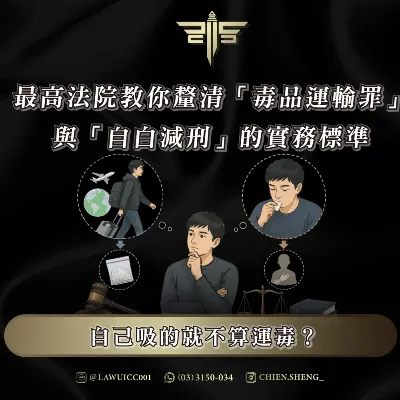 自己吸的毒品帶回家也算運輸嗎?最高法院解析運輸毒品罪、持有界線與自白減刑毒品是自己要吸的,就一定不算運輸毒品嗎?最高法院指出,「供自己施用」並不是排除運輸罪的唯一標準,長途、大量異地搬運仍可能成立運輸毒品重罪。本文解析最高法院115年度台上字第2358號判決,帶您了解持有與運輸毒品的界線,以及承認運送事實、但爭執罪名時,是否仍能適用自白減刑。毒品案件知識文 2026.09.08
 供出毒品來源可以減刑嗎?毒品危害防制條例第17條解析:法院未調查清楚,能否上訴最高法院?供出毒品來源可以減刑嗎?本文解析毒品危害防制條例第17條第1項,以及最高法院115年度台上字第1292號刑事判決的重要見解。若被告具體供出本案毒品來源,並因此查獲其他正犯或共犯,法院依法應評價是否減輕或免除其刑。若法院未調查被告供出毒品來源後是否因而查獲,就逕行判決,可能構成應調查證據未調查的違背法令,並可作為上訴最高法院的重要理由。本文也說明毒品案件中如何透過律師協助供述來源、聲請法院調查與爭取減刑。毒品案件知識文 2026.06.02
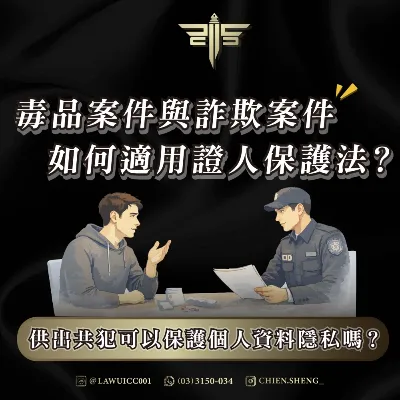 毒品、詐欺案件供出共犯可以減刑嗎?證人保護法適用、身分保密與個資保護完整解析供出毒品上游或詐欺共犯可以減刑嗎?解析證人保護法、身分保密、個資保護與檢察官事先同意的關鍵。毒品案件知識文 2026.06.05
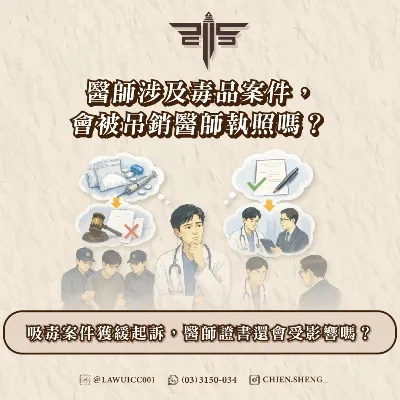 醫師吸毒會被吊銷執照嗎?緩起訴影響解析|謙聖律師醫師吸毒獲得緩起訴,還會被廢止醫師證書嗎?本文整理判刑確定、緩起訴、緩刑、執業執照與醫師懲戒的差異,說明醫師涉毒案件真正需要防範的法律風險。毒品案件知識文 2026.08.13